


Reborn (2023-ongoing)
Photographed from above a volcanic wetland landscape shaped by an ancient eruption, Reborn explores emergence, transformation, and cyclical life processes through the shifting relations of snow, ice, and water.
The interplay of light and shadow becomes a quiet metaphor for life, death, and renewal in continuous transformation.
太古の噴火によって形成された火山性湿地の風景を上空から撮影し、
『Reborn』は、雪・氷・水の移ろう関係のなかに、生成・変容・生命の循環を探る作品である。
光と影の交錯は、生と死、そして再生が連続する変容のメタファーとして静かに立ち現れる。

Statement
Reborn captures a fleeting moment that emerged by chance from the cyclical flow of life energy, unfolding a visual exploration of the fundamental questions that lie between life and creation.
The photograph was taken from above a wetland area in Yamagata Prefecture, formed within a volcanic crater by an eruption that occurred tens of thousands of years ago. Although the site was once marked by violent geological activity, the traces of eruption have gradually softened over time.
Today, it no longer appears as a distinct volcanic crater, but as a water-rich forest landscape in which wetlands of various scales extend across the terrain. Within this environment, more primordial marshland coexists with areas partially shaped by human intervention, while a rich ecosystem of water and forest—including raised bog formations—still remains.
Located in a region of heavy snowfall, the surface of the water accumulates snow, which gradually becomes the nucleus through which water transforms into ice. As snow mingles with water and temperatures fall, the water freezes; when touched again by sunlight, it melts back into liquid form. Throughout this perpetual cycle, delicate patterns quietly emerge upon the surface.
These formations are in constant flux—shaped by subtle shifts in temperature, the amount of snowfall, the movement of wind, the heat emitted by wetland vegetation, and even the minute currents that ripple beneath the surface. Guided by long-term field observation, the work emerges from a photographic practice that listens for the conditions under which unpredictable natural forms may briefly appear.
Such a confluence of countless contingencies gives rise to spontaneous phenomena, in which light and shadow intertwine, symbolizing the existential duality of life, death, and rebirth, quietly emerging as a metaphor for the eternal cycle of reincarnation.
For Kazuaki Koseki, these unpredictable and self-renewing natural phenomena evoke the very moment when a living being is reborn. Captured through a remote, signal-mediated perspective, the work displaces the human eye from the center of authorship, allowing natural processes themselves to determine the moment of emergence.
Part of the photographic quartet “The Cycle of Being”.
→ Artist’s Statement / Philosophy
『Reborn』は、生命エネルギーの循環のなかから偶然に立ち現れた一瞬のドローイングを通して、生命と創造のあわいに潜む根源的な問いを視覚的に探求した作品である。
写真は、数万年前の噴火によって形成された山形県の火山クレーター内の湿地帯を、上空から撮影したものである。
この場所はかつて激しい地質活動の痕跡を宿していたが、長い時間のなかでその輪郭は次第に穏やかになった。
現在では、もはや明確な火口の姿をとどめておらず、豊かな湧水に支えられた森の風景のなかに、大小さまざまな湿地が広がっている。
そこでは、原生的な湿地と人為的に整えられた湿地とが入り混じりながら、水の豊かさを湛えた生態系と、高層湿原を含む森の自然が今も息づいている。
この地域は豪雪地帯に位置し、水面に降り積もる雪が核となって、やがて水は氷へと変容していく。
雪が水と混ざり合い、気温が下がると氷となり、太陽の光によって再び液体へと戻る。
これらの模様は、気温のわずかな変化、降雪量、風の動き、湿地の植物が発する熱、さらには微細な水の流れなど、無数の要因が重なり合うことで絶えず変化し続ける。
長期のフィールド観察に導かれた本作は、予測不可能な自然の形態が一時的に立ち現れる条件に耳を澄ます写真実践から生まれている。
数多の蓋然が幾重にも重なり生まれる偶然性。
そこに現れる光と影は、生と死、そして再生という実存的な二元性を象徴し、生命が永遠に循環する輪廻のメタファーとして静かに立ち現れる。
予測不可能に繰り返されるこの現象は、小関一成にとって、生き物が生まれ変わる瞬間そのものを想起させるものである。
本作は、信号を介した遠隔的な視点によって撮影され、人間の視線を作者性の中心から退かせ、自然のプロセスそのものが像の生成を決定する構造を持っている。
(写真四部作「存在の輪廻」より)
→ Artist’s Statement / Philosophy

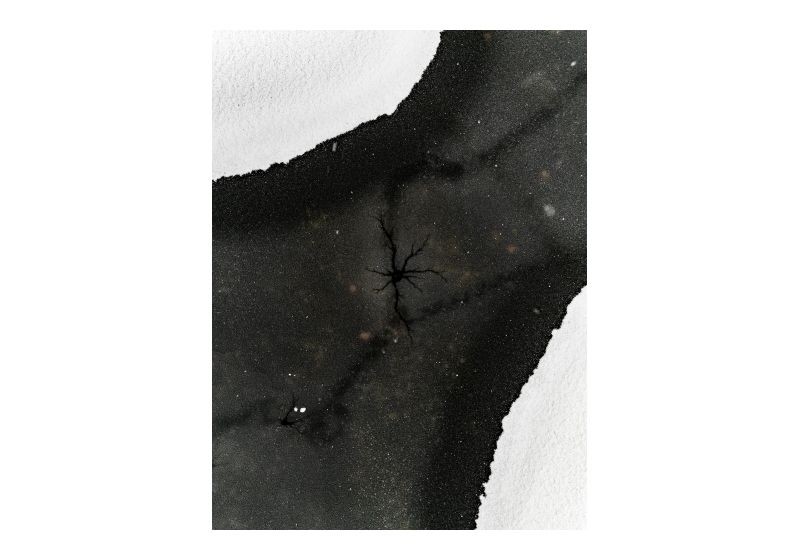
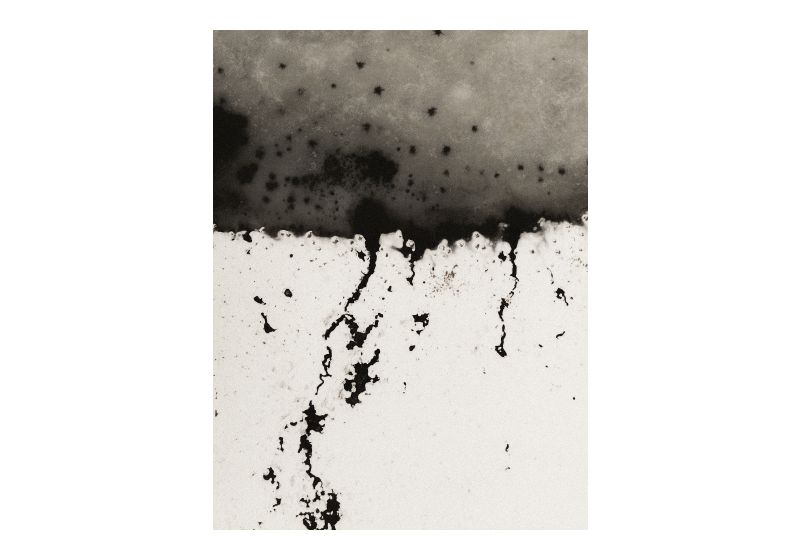
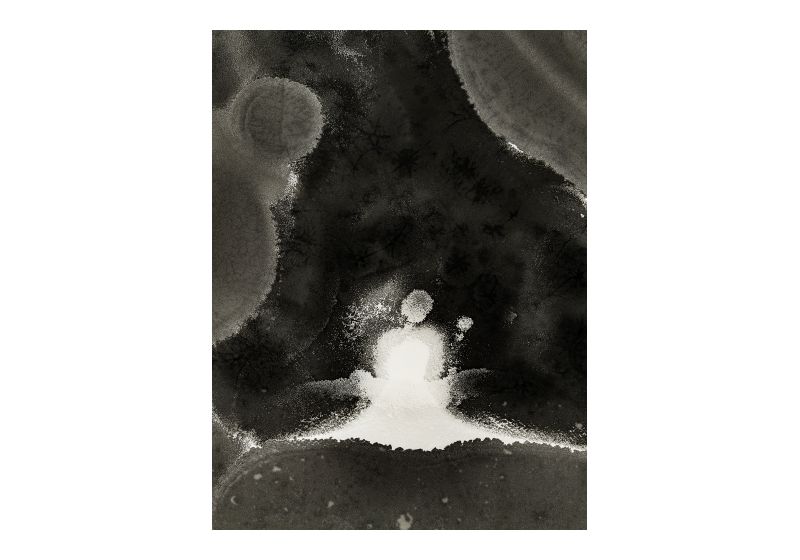
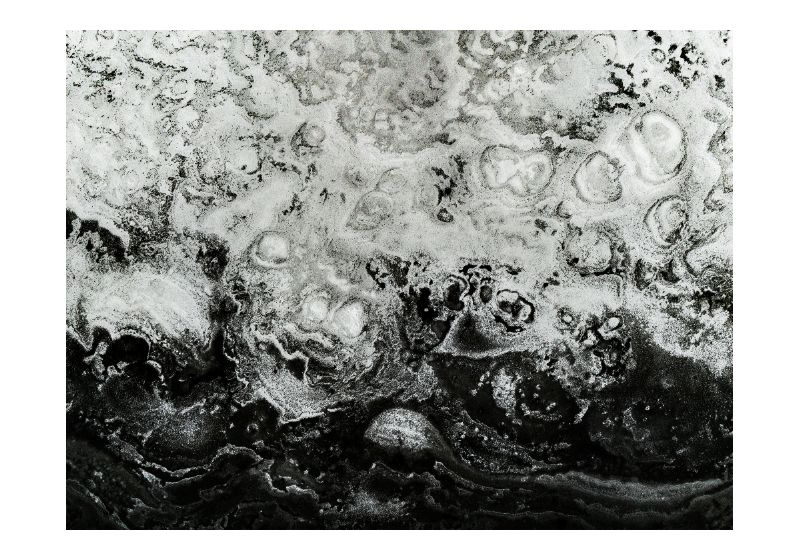
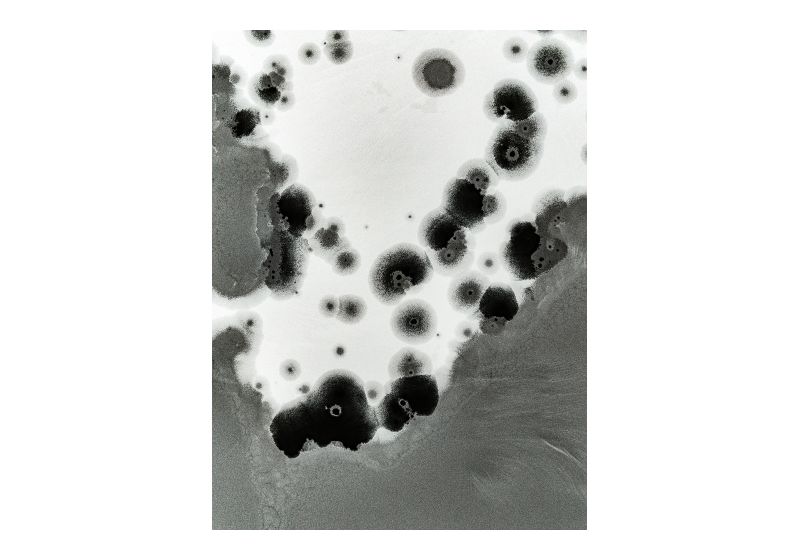
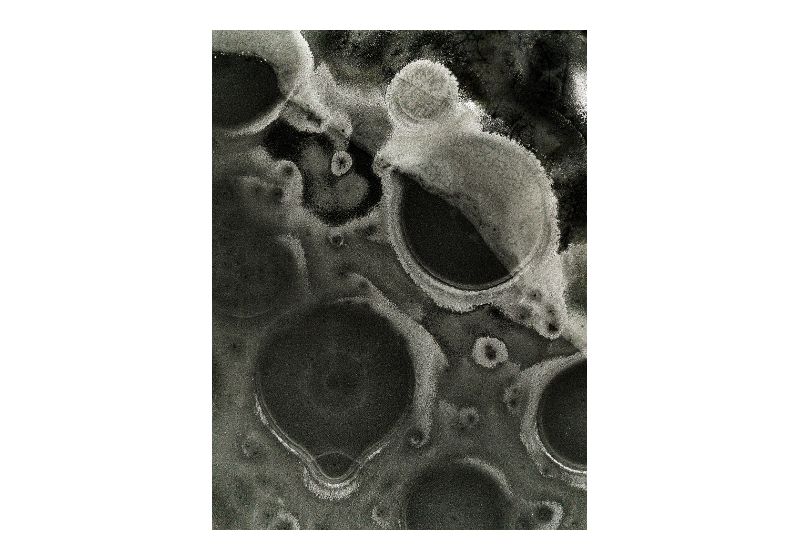
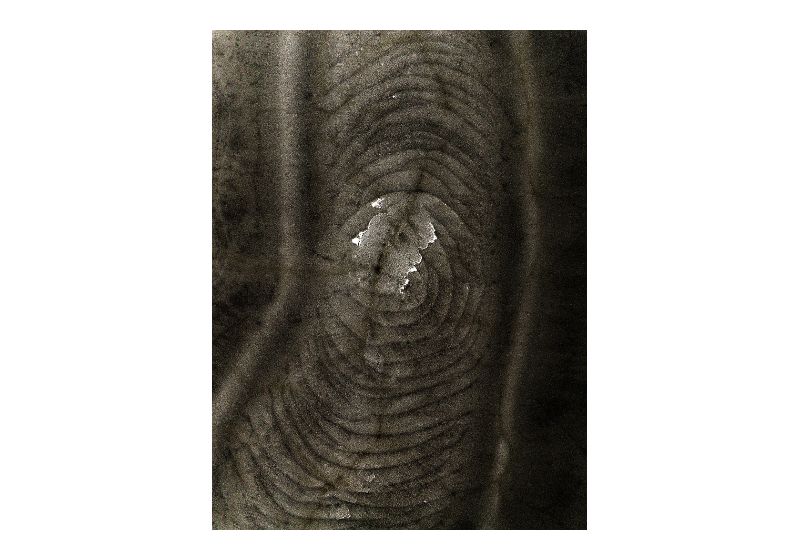
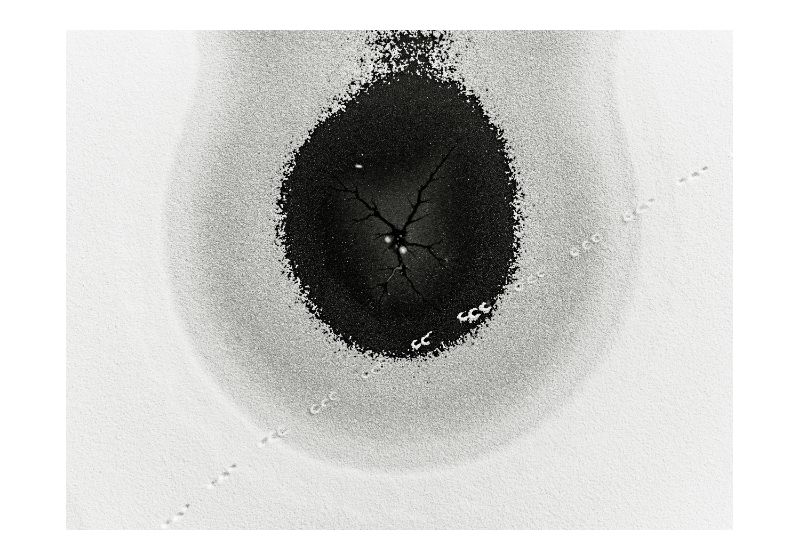
Reborn reconsiders photography not as an act of imposition, but as an act of recognition. Rooted in long-term field observation of a volcanic wetland in Yamagata Prefecture, the work attends to a landscape in which snow, ice, water, light, wind, vegetation, and temperature continuously interact, generating unstable formations on the surface.
Rather than composing the image in advance, the artist learns to sense where and when a phenomenon may emerge. This attentiveness—connected to Koseki’s idea of “listening” to nature—does not eliminate unpredictability, but frames photography as a practice suspended between perceptual preparation and contingency.
Produced through drone-based, signal-mediated observation, Reborn shifts the human eye away from the center of authorship. The drone functions not as an extension of the body, but as a perceptual intermediary, introducing distance, transmission, and temporality into the act of seeing.
Within this structure, photography remains crucial. The image begins when a temporary formation appears on the surface and the artist responds to it. In Reborn, selection does not mean compositional control, but the discernment of the threshold at which natural emergence becomes photograph.
Although Reborn formally began in 2023 through drone-based observation, its conceptual foundation is rooted in long-term fieldwork initiated in the winter of 2015, when the artist first encountered these formations and began tracing their conditions through sustained observation of terrain, seasonal change, vegetation, and climate.
『Reborn』は、写真を何かを「作る」行為ではなく、自然の生成を「認識する」行為として捉え直す試みである。山形県の火山性湿地における長期のフィールド観察に根ざし、本作は、雪、氷、水、光、風、植生、気温といった複数の要素が絶えず作用し合うことで、水面に不安定な形態が生成される風景に向き合っている。
このシリーズにおいて作家は、あらかじめ像を構成するのではなく、現象が立ち現れうる場所と時間を感じ取っていく。この注意深い感受は、小関の「自然に耳を澄ます」実践に結びついているが、それによって予測不可能性が消えるわけではない。むしろ写真は、知覚の準備と偶有性のあいだに宙吊りにされた実践として立ち現れる。
ドローンによる信号媒介的な観測を通じて、『Reborn』は人間の視線を作者性の中心から退かせる。ドローンは身体の延長としてではなく、知覚の媒介装置として機能し、距離、伝達、時間性を視覚のプロセスへと導入する。
そのうえで、写真という行為はなお重要である。無数に変化し続ける現象のなかで、水面に一時的な形態が立ち現れ、それに作家が応答する瞬間に像は生まれる。『Reborn』における選択とは、構図を支配することではなく、自然の生成が写真へと移行する閾値を見極めることである。
《Reborn》は2023年にドローンによる観測として成立したが、その概念的基盤は、作家が2015年の冬に初めてこれらの形態に出会い、以来、地形、季節変化、植生、気候を持続的に観察しながら、その発生条件を探ってきた長期のフィールドワークに根ざしている。
Reborn reframes photography as an act of recognition rather than authorship, positioning natural processes—rather than human intention—as the primary agents in the emergence of form.
The work is grounded in a non-anthropocentric approach to photographic practice, in which the image is understood not as a product of human vision but as the temporary manifestation of autonomous natural processes.
In Reborn, the photographic act begins before the image appears. Through long-term field observation, the artist learns to sense where and when a phenomenon may emerge—reading subtle shifts in terrain, snow, temperature, wind, and water. This anticipatory awareness, rooted in Koseki’s idea of “listening” to nature, does not eliminate unpredictability; rather, it frames photography as a practice suspended between attentiveness and contingency. The image is therefore neither fully planned nor purely accidental, but born from the meeting of perceptual preparation and autonomous natural transformation.
The work is produced through aerial observation using a drone, a device that functions as a perceptual intermediary rather than an extension of the human body. Unlike embodied flight practices, the drone introduces distance, latency, and signal transmission into the act of seeing. Vision is therefore no longer immediate but mediated, structurally resembling the way sensory information travels from the eye to the brain through neural transmission.
Within this structure, authorship is neither centered in subjective expression nor dissolved entirely. Natural processes generate the conditions of form, while the artist recognizes when a temporary configuration crosses the threshold into photographic form. The shutter is activated not as an act of control, but as a response to emergence. Authorship is thus redistributed across environment, technology, time, and perception.
Reborn situates photography within a collaborative and distributed field in which form is not imposed, but allowed to emerge. Existence is revealed here not as stable form, but as continuous transformation—an ongoing process in which appearance, disappearance, and regeneration remain inseparable.
『Reborn』は、写真を作者による表現行為ではなく、自然のプロセスが形を立ち上げる瞬間を認識する行為として捉え直す。
本作は、人間中心の視覚表現から距離を取り、像を人間の視覚の産物ではなく、自律的な自然プロセスの一時的な顕在として理解する、非人間中心的な写真実践に基づいている。
『Reborn』における写真行為は、像が現れる以前から始まっている。作家は長期のフィールド観察を通して、地形、雪、気温、風、水の状態の微細な変化を読み取り、現象が立ち上がりうる場所と時間を感じ取っている。この予兆への感受は、小関の「聴く写真論」に根ざしているが、それによって予測不可能性が消えるわけではない。むしろ写真は、注意深い応答と偶有性のあいだに宙吊りにされた実践として立ち現れる。したがって像は、完全に計画されたものでも、純粋な偶然でもなく、知覚の準備と自律的な自然変容との出会いから生まれるのである。
本作はドローンによる上空からの観測によって制作されているが、ここでドローンは身体の拡張ではなく、知覚の媒介装置として機能する。身体的飛行とは異なり、ドローンは見るという行為のなかに距離、遅延、信号伝達を導入する。その結果、視覚は即時的な体験ではなくなり、その構造は人間の目から脳へ感覚情報が神経伝達される仕組みにも通じている。
この構造において、作者性は主観的表現に集中するのでも、完全に消失するのでもない。自然のプロセスが形の条件を生成し、作家はその一時的な構成が写真として成立する閾値を見極める。シャッターは制御の行為としてではなく、生成への応答として切られる。したがって作者性は、環境、技術、時間、知覚へと分散されている。
このように『Reborn』は、環境、技術、時間、知覚が交差する協働的かつ分散的な場のなかに写真を位置づける。ここで存在は固定された形ではなく、変容し続ける運動として示される。そこでは、出現、消失、再生が切り離せない。
This landscape has been familiar to me since childhood. I first visited it as a place for learning about nature, and later returned to it many times through photographic work and personal observation.
For years, I thought of it simply as an ordinary place close to my daily life. Yet its seasonal changes, the clarity of its water and air, and its quiet vitality continued to draw me back, and I gradually began photographing its lakeshore, wetlands, and surrounding forest more closely.
Only later did I learn that this terrain had been shaped by volcanic activity, and that the mountain itself had long been associated with local reverence and belief. That knowledge did not alter my experience of the place, but deepened the way I understood it.
Many of my works, including Aquascape and Reborn, are connected to this landscape. What I continue to photograph here is not only scenery, but a place where nature, time, memory, and a deeper sense of presence remain layered together.
この風景は、幼い頃から私にとって親しい場所であった。自然を学ぶ場として初めて訪れ、その後も撮影の仕事や個人的な観察を通して、何度もこの場所に通ってきた。
長いあいだ、私はこの場所を、ただ生活の近くにあるありふれた風景のひとつだと思っていた。けれども、季節ごとに移り変わる姿、水や空気の清らかさ、そして静かな生命感に惹かれ、やがて湖畔や湿地、その周囲の森を繰り返し撮影するようになった。
その後になって、私はこの土地が火山活動によって形づくられたこと、そして山そのものもまた地域の信仰と結びついてきた存在であることを知った。その事実は、この場所に対する私の感覚を変えたのではなく、むしろその見方をより深めるものとなった。
Aquascape や Reborn を含む私の作品の多くは、この風景とつながっている。私がここで撮り続けているのは、単なる景色ではなく、自然、時間、記憶、そしてより深い気配が幾層にも重なり合う場所である。
Developed through long-term field observation since 2015.
2015年より継続して行っているフィールド観察に基づく。
Location: Yamagata Prefecture, Japan
Year: 2023–ongoing
Medium: Photography (Drone)
Method: Signal-mediated aerial observation
Research: Developed through long-term field observation since 2015.
Exhibition
2025 | Sony World Photography Awards 2025 exhibition | Somerset House, London, UK
Awards
2025 Sony World Photography Awards 2025 Professional competition,Landscape,Shortlist
Features/Publications/Press